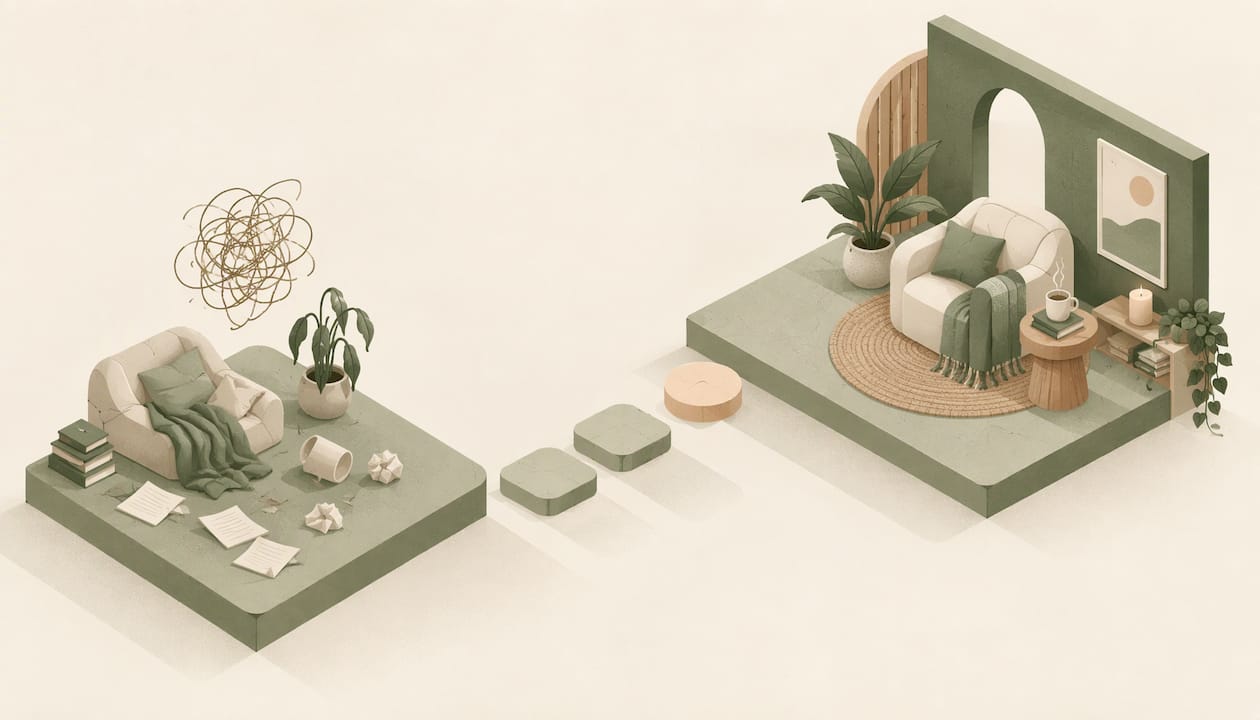
The fastest way to calm down is to slow your breathing, with a longer exhale than inhale, and then give your mind something concrete to do, such as naming what you can see or counting backwards. Both steps work on the body first, so you don't need to win an argument with your thoughts. Most of what follows takes between one and five minutes, needs no equipment and works at a desk, in a car or in a hallway. If you want a gentler place to practice afterward, we built Nookdle as a pressure-free space for check-ins and reflection, and we come back to it near the end.
TL;DR
- Breathe out longer than you breathe in. A pattern like in for 4, hold for 4, out for 6, repeated about 10 times, is one that the American Psychological Association lists.
- Pull your attention into the present with the 5-4-3-2-1 senses exercise or by counting backwards from 100 in threes.
- Release your body: tense a muscle group, then let go, and move if you can.
- If you feel panicky, stay put, breathe slowly and remind yourself it will pass. If anxiety is constant or disrupting your life, talk to a health care provider. In a crisis, call or text 988 in the US.
- Treat calming as a skill. It gets easier with practice, so start before you are overwhelmed.
Table of Contents
- Why slowing down works on your body first
- Step 1: Slow your breathing (1 to 5 minutes)
- Step 2: Ground yourself in the present (2 to 3 minutes)
- Step 3: Give racing thoughts a task
- Step 4: Release the tension in your body
- Step 5: Move, listen, smell, talk
- How to calm down when you are anxious or panicking
- Build the habit before you need it
- Where Nookdle fits
- When to talk to a professional
- FAQ
- Sources
Why slowing down works on your body first
When you feel stressed, your breathing tends to become fast and shallow, and that can make you feel more anxious. Cleveland Clinic integrative medicine specialist Melissa Young, MD, explains this loop and says deliberate breathing helps move you out of fight-or-flight and toward the calmer parasympathetic state. She adds that the nervous system can be trained to react less to stress.
There is a practical reason breathing is the first tool to reach for. Breathing is the one automatic body function you can easily control on purpose, according to the SIU School of Medicine. Your heart rate rises slightly as you breathe in and falls as you breathe out, so a longer exhale nudges your heart rate down.
That is also why "just relax" rarely works. You can't command a feeling, but you can change your breath, your focus and your muscle tension, and the feeling often follows.
Step 1: Slow your breathing (1 to 5 minutes)
Pick one pattern and stay with it. The exact numbers matter less than breathing slowly and making the exhale at least as long as the inhale. Sit or stand comfortably, and breathe in through your nose if you can.
Here are patterns published by health bodies:
| Pattern | How it goes | Source |
|---|---|---|
| 4-4-6 | In 4, hold 4, out 6, repeat 10 times | APA |
| 3-3-3-3 | In 3, hold 3, out 3, hold 3, repeat for a few minutes | NHS inform |
| 4-4-4-4 (box breathing) | In 4, hold 4, out 4, hold 4, three to four rounds | Cleveland Clinic |
| 4-2-6 | In 4, hold 2, out 6; beginners can use 3-1-4 | Healthy WA |
| 4-4-6-2 | In 4, hold 4, out 6, hold 2 | SIU School of Medicine |
If you have never tried any of these, start with 3-3-3-3 or the beginner 3-1-4. The NHS notes its version can be done anywhere and suggests repeating for at least 5 minutes, counting to 5 on each breath if that feels natural. NHS inform adds that controlled breathing can be particularly helpful if anxiety leaves you dizzy or light-headed.
Where breathing exercises go wrong
The most common mistake is breathing too hard. Deep does not mean forceful. Aim for slow, quiet, belly-led breaths. Healthy WA recommends stomach (diaphragmatic) breathing, and says normal breathing is about 10 to 12 breaths per minute, so slowing below that is the goal.

A second mistake is counting so strictly that it becomes another source of pressure. If a hold of 4 feels uncomfortable, shorten it. If you notice lightheadedness, return to normal breathing. The SIU School of Medicine cautions that the 4-4-6-2 pattern may worsen severe asthma or COPD, so if you have a lung condition, check with your doctor about which breathing exercises suit you.
Step 2: Ground yourself in the present (2 to 3 minutes)
Anxious thoughts are almost always about the future or the past. Grounding gives your attention somewhere real to land. Cleveland Clinic describes the 5-4-3-2-1 technique, which uses all five senses:
- Name five things you can see.
- Name four things you can feel (your feet on the floor, the chair under you).
- Name three things you can hear.
- Name two things you can smell.
- Name one thing you can taste.
Say them out loud or in your head, slowly. If you can't find a smell or a taste, imagine your favorite one or note what is already in your mouth. The point is to move out of your head and into your surroundings. Cleveland Clinic's Dr. Albers says that focusing on a sensory experience moves you out of your head and into your body, and that simply naming your feelings can help settle them.
Two simpler variations come from public health sources. The New York State Office of Mental Health suggests naming objects of a chosen color in the room around you. The University of Bath suggests naming items in a category or reciting the alphabet backwards. Pick a category that takes a little effort, such as countries or foods, so your mind has something to work on.
Step 3: Give racing thoughts a task
When thoughts loop, arguing with them tends to feed them. A better move is to occupy the part of your brain that is spinning. The APA suggests counting backwards from 100 by threes: 100, 97, 94 and so on. The structured focus on a distracting task can interrupt unhelpful thought patterns.
This works best when the task is slightly hard. Counting backwards by ones is too easy, and your worries will talk over it. If you lose your place, start again without comment. That is the exercise, not a failure.
The APA's list also includes thinking of three things that went well today. It is a quick way to shift from threat-scanning to noticing what is already fine. If your mind refuses, make them tiny: the coffee was hot, a coworker said hello, the bus came.
Step 4: Release the tension in your body
Stress lives in your shoulders, jaw and hands long before you name it. Progressive muscle relaxation uses a simple contrast: tense, then let go.
The APA describes tensing each muscle group for 10 seconds, then releasing. The Mayo Clinic describes a gentler version, tensing for about 5 seconds and relaxing for about 30, moving from toes to head or head to toes in a quiet spot. Either way works. Here is a quick sequence:
- Curl your toes and press your feet into the floor. Hold, then release.
- Tighten your calves and thighs. Hold, then release.
- Clench your fists. Hold, then release.
- Shrug your shoulders to your ears. Hold, then release.
- Scrunch your face, then let your jaw hang loose.
Avoid tensing so hard that it hurts, and skip any area that is injured or painful. Notice the difference between tight and loose each time. That contrast is what teaches your body what relaxed feels like.
Step 5: Move, listen, smell, talk
If you have a few more minutes, these small additions come from Cleveland Clinic's list of six ways to calm yourself down:
- Get moving. A walk around the block gives nervous energy somewhere to go. Cleveland Clinic's Dr. Tworek explains that physical activity releases endorphins and lets the body work out energy that would otherwise show up as irritability.
- Play calming music. The same page notes that research shows music can ease anxiety and lower heart rate, respiratory rate and blood pressure.
- Use a calming scent. Lavender or any smell you associate with comfort can anchor you.
- Talk to someone. Say plainly that you feel nervous. Naming it out loud, to a friend or a colleague you trust, often takes some of the charge out of it.
- Write it out. The University of Bath suggests writing down what you're feeling, which gets the swirl out of your head and onto something you can look at.
That last one deserves a note. Putting a feeling into words, even three or four of them, is a small act of reflection, and it is the habit that makes the faster techniques easier to reach for later.
How to calm down when you are anxious or panicking
Anxiety that comes on hard feels different from ordinary stress, and the advice changes a little. For a panic attack, NHS inform advises staying where you are if it is safe to, breathing slowly and deeply, and reminding yourself that you are not in danger and the attack will pass. It also says fighting a panic attack can make it worse. The goal is to let the wave crest rather than stop it by force.
A sequence many people find workable:
- Stop and name it. Say to yourself, "This is anxiety. It is uncomfortable, and it will pass."
- Breathe out slowly. Use a pattern from the table, or simply breathe out as if through a straw.
- Ground. Press your feet into the floor and do a round of 5-4-3-2-1.
- Stay with it for a few minutes. Don't check whether it is working every ten seconds.
Australia's Lifeline says a grounding technique such as box breathing can help you regain a sense of control within minutes, and lists uses including stopping rumination and managing intrusive thoughts.
Chest pain, trouble breathing or symptoms that feel different from your usual anxiety need medical attention. Call 911 or your local emergency number rather than waiting it out.
Build the habit before you need it
The quick techniques above work best when they are familiar. Cleveland Clinic recommends practicing box breathing one or two times a day, and Healthy WA gives similar advice for its pattern. The Mayo Clinic frames relaxation techniques as skills: your ability to relax improves with practice, and you should be patient with yourself so that trying them doesn't become another stressor.
A few ways to make that stick:
- Anchor it to something you already do. Three slow breaths while the kettle boils, or one round of grounding on the walk to your car.
- Rehearse when you are fine. You will remember the steps under pressure only if you have done them when calm.
- Notice what helps. Some people respond best to breathing, others to movement or to naming what they see. Keep a short note of what worked.
- Keep it light. If a routine starts to feel like homework, shrink it.
Where Nookdle fits
Nookdle is a self-guided wellbeing space for adults, built around a customizable virtual room and fictional companions. It is a place to practice the "notice and name it" part of calming down: you can check in with your mood, save a meaningful memory or photo, and talk with a companion who offers scripted reflection prompts. Our companions are not therapists, and the activities are optional rather than treatment.

We designed it with no streaks and no pressure to return every day, so a missed day costs you nothing. That matters when the goal is feeling calmer rather than keeping a score.
Nookdle is free to explore. Sanctuary Plus is an optional membership at $9.99 per month that adds expanded rooms, companions, memory storage and in-app rewards. You can see what each plan includes on our membership page, or start at Nookdle.

We also publish a weekly psychology newsletter and free editorial content on everyday wellbeing, so you can learn more about why these techniques work at your own pace.
When to talk to a professional
Quick techniques help with moments of stress. They are not a substitute for care when anxiety is persistent. The National Institute of Mental Health says that when anxiety starts to cause problems at school, at work or with friends and family, it is time to seek professional help. It suggests starting with a health care provider such as a primary care doctor, psychiatrist, psychologist or clinical social worker.
The Mental Health Foundation lists signs worth raising with your doctor: feeling anxious all the time for several weeks, fears or phobias taking over your life, or having panic attacks. It notes that talking therapies are effective, that cognitive behavioral therapy (CBT) is the most commonly used for anxiety, and that support groups can help.
If you are thinking about harming yourself or feel you are in crisis, call or text 988 in the US. The 988 Lifeline offers free, 24/7 support. For a medical emergency, call 911.
FAQ
How long does it take to calm down?
Many people notice a shift within one to five minutes of slow breathing. The NHS suggests repeating its breathing exercise for at least 5 minutes. If it takes longer the first few times, that is normal, because these are skills that improve with practice.
What is the fastest way to calm down when anxious?
Slow your breathing with a longer exhale, such as in for 4, hold for 4, out for 6, and repeat about 10 times. Then add grounding by naming five things you can see. Pairing breath with attention tends to settle both body and mind.
Why do I feel worse when I try to calm down?
Trying too hard can add pressure. Mayo Clinic advises being patient with yourself so relaxation doesn't become another stressor. Shorten the breath counts, loosen your grip on getting it right and try a gentler technique such as naming colors in the room.
Can I calm down without breathing exercises?
Yes. Grounding with your senses, counting backwards by threes, tensing and releasing muscles, walking, listening to calming music and talking to someone are all options from the sources above. Choose whichever feels most natural in the moment.
Is feeling anxious all the time normal?
Occasional anxiety is a normal part of life, but feeling anxious all the time for several weeks is a reason to talk with your doctor, according to the Mental Health Foundation. Effective treatments exist, and asking for help is a sound first step.
Sources
- APA: Stress management tools
- New York State Office of Mental Health: 5 Ways to Calm Yourself
- University of Bath: Overwhelming feelings
- NHS inform: Controlled breathing exercise
- NHS: Breathing exercises for stress
- Healthy WA: Calming techniques, breathing training
- SIU School of Medicine: Breath and wellness
- Cleveland Clinic: Box breathing benefits and techniques
- Cleveland Clinic: 5-4-3-2-1 grounding for anxiety
- Cleveland Clinic: How to calm anxiety, 8 techniques
- Cleveland Clinic: 6 ways to calm yourself down
- Mayo Clinic: Relaxation techniques
- Lifeline Australia: Finding relief through grounding techniques
- NIMH: Generalized anxiety disorder
- Mental Health Foundation: How to manage fear and anxiety
- SAMHSA: 988 Suicide & Crisis Lifeline
- NHS inform: Panic disorder